en

Digitally Designed Lab Appliances
Results 1-8 of 8

db
Quotation

Micro 2
Hyrax-like device, exclusively anchored on palatal 2 screws.
With the development of digital technology, it is now possible to digitally design the screw positions based on CT. Thus, a drilling template can be made and the device can be printed, thus obtaining an accurate device that can be anchored in one sitting
db
Quotation

Micro 4
Hyrax-like device, exclusively anchored on palatal 4 screws.
With the development of digital technology, it is now possible to digitally design the screw positions based on CT. Thus, a drilling template can be made and the device can be printed, thus obtaining an accurate device that can be anchored in one sitting.
db
Quotation

Hyrax appliance
A rapid dilator, which works by tearing the labial suture and is used to dilate the upper dental arch skeletal body. It is usually anchored on 4 bands (first molars, first premolars, or possibly milk canines) It is advisable to perform a direct band test in the office. The bands are soldered to the metal arms of the Hyrax screw or possibly laser welded. The ideal expansion rate is 0.8-1 mm per day. The required dilation is overcompensated by 1-3 mm. The device is then left on for at least three months for retention. Can also be made with metal printing.
db
Quotation

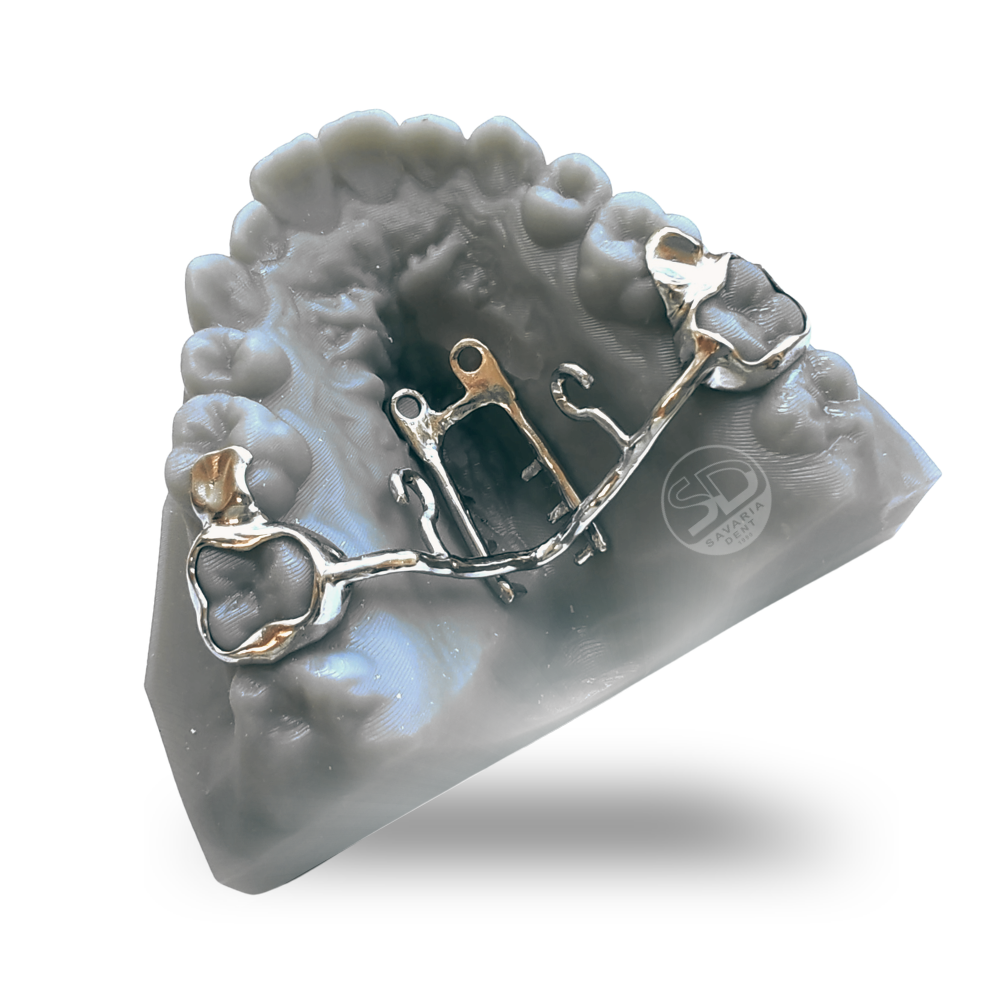
MCPP appliance
(Modified C-Palatal Plate) The appliance consists of two parts.
1. A palatal arch anchored to the upper sixths that follows the contour of the upper dental arch. Its anterior portion has hooks for attaching elastic bands.
2. A thick plate (cast or 3D-printed metal) positioned along the line of the molars, anchored to mini-screws placed in the middle of the palate. It has hooks for attaching elastic bands.
By flexibly connecting the two components, we can distally move the molars to a skeletal anchor.
db
Quotation

MSE appliance
Maxillary Skeletal Expander (MSE) is a specific type of Miniscrew Assisted Rapid Palatal Expander (MARPE), capable of producing large maxillary and midface expansion in young as well as in adult patients.
The MSE uses 4 TADs for fixation to the palate and a wrench for activation. It attaches to 2 molar bands via 4 legs for stabilization.
It is indicated in the treatment of posterior cross bite, Class III malocclusions and it is able to improve nasal airflow and breathing. Recent publications show the positive effects also in the therapy of Obstructive Sleep Apnea (OSA).
db
Quotation